
Michael O’Regan, Glasgow Caledonian University
Sep 08, 2025

Introduction
The academic literature on sustainable tourism frequently showcases certain destinations as exemplars of best practice, with Bhutan standing as perhaps the most celebrated case study, its ‘high-value, low-impact’ tourism policy seen as a replicable model for addressing overtourism and achieving sustainable development (Rinzin et al., 2007). This idealisation extends beyond tourism studies into broader development discourse, where Bhutan’s Gross National Happiness (GNH) philosophy is presented as an alternative to GDP-focused growth models.
This opinion piece explores the tendency to idealise Bhutan as a sustainable tourism model, arguing that such academic idealisation creates a dangerous disconnect between theoretical models and lived realities, with academic romanticisation often obscuring complex realities and internal contradictions that challenge the sustainability and transferability of such models. Drawing on Hermann Rorschach’s famous inkblot test metaphor, we argue that Bhutan functions as a ‘Rorschach nation’ where observers project their own sustainability aspirations rather than engaging critically with the country’s tourism model and evolving challenges.
The Construction of Bhutan as a Sustainable Tourism Ideal
Over the past five decades, Bhutan has been positioned as a global template for sustainable tourism, and a pioneering example of tourism degrowth and sustainability. Despite some scholars acknowledging the significant complex trade-offs that accompany tourism development in Bhutan (Nyaupane and Timothy, 2010), many believe Bhutan’s model is transferable to other destinations (Brunet et al., 2001; Schroeder, 2015). CB Ramkumar, Vice Chairman of the Global Sustainable Tourism Council, explicitly advocates for replication, arguing that “Bhutan was proof of concept. It can be replicated across any scale, any geography, anywhere in the world.” (Peak Travel, 2025). Rudigier (2023) argues that “By adopting Bhutan’s balanced approach, Europe has the potential to pioneer its own models of success in the green tourism industry.” Dr. Tandi Dorji (2001, 91), Foreign Minister for Bhutan from November 2018 to January 2024 states that “Bhutan is perhaps the best example where controlled tourism has been effective in ensuring the sustainability of the industry in the long run.” Bali, inspired by Bhutan is currently considering imposing a daily tax on foreign tourists, and has since February 2024, imposed a fee of IDR 150,000 (US$9) on every foreign tourist visiting Bali for tourism purposes, to protect Bali’s culture, customs, and natural environment, as well as improve tourism management quality. In New Zealand, a NZ$100 (US$58) Visitor Conservation and Tourism Levy (IVL) has been imposed on most international tourists since 2019.
There is no doubt there is a western academic fascination with Bhutan, as Bhutan provides a convenient repository for Western anxieties about unsustainable development, allowing scholars to project idealised solutions onto a distant location which has strategically focused on attracting ‘high value, low volume’ tourists since 1974 to minimise environmental impacts. Scholars have largely supported its Sustainable Development Fee (SDF), which currently requires tourists to pay US$100 per person per night, as well as for a visa, accommodation, meals, transport, and guide services.
Academic and expert consensus has created what might be termed a ‘sustainability halo effect’ around tourism in Bhutan, with little discussion on internal contradictions and evolving challenges, largely because of methodological limitations that compromise critical analysis. The country’s access policies, paradoxically limit researchers’ ability to observe negative impacts or gather dissenting perspectives. Furthermore, the tendency toward confirmation bias leads researchers to seek evidence supporting preexisting beliefs about Bhutan’s success rather than critically examining policy failures or unintended consequences, particularly given the scarcity of demonstrably successful sustainable tourism models that might serve as comparative benchmarks for rigorous analysis.
The Reality of Contemporary Challenges
Economic Pressures and Policy Contradictions
The Bhutanese Ngultrum is pegged to the Indian Rupee (1 BTN = 1 INR), which limits Bhutan’s monetary policy independence and makes the country vulnerable to fluctuations in the Indian economy. As the currency cannot appreciate against other currencies, particularly the Indian Rupee, Bhutan’s tourism recovery has been slower than other Asian destinations post-pandemic. Tourists comparing regional options see better value in countries with more flexible exchange rates that can adapt to global economic conditions. In addition, limited flights to Bhutan, are operated either by DrukAir or Bhutan Airlines, creating a monopoly effect. As many tourism inputs are imported, making them subject to both global price increases and the fixed INR exchange rate, the inputs that tourism businesses require for their own production, rather than selling directly to final consumers are also rising in cost (financial services, construction, transport, food and beverages) means higher costs for transport, hotels and restaurants, and travel agencies. Reduced tourist numbers, and a high concentration of loans (61.3% as of December 2022) in services, including the tourism sector, poses financial stability risks (Penjor, 2019; World Bank, 2024).
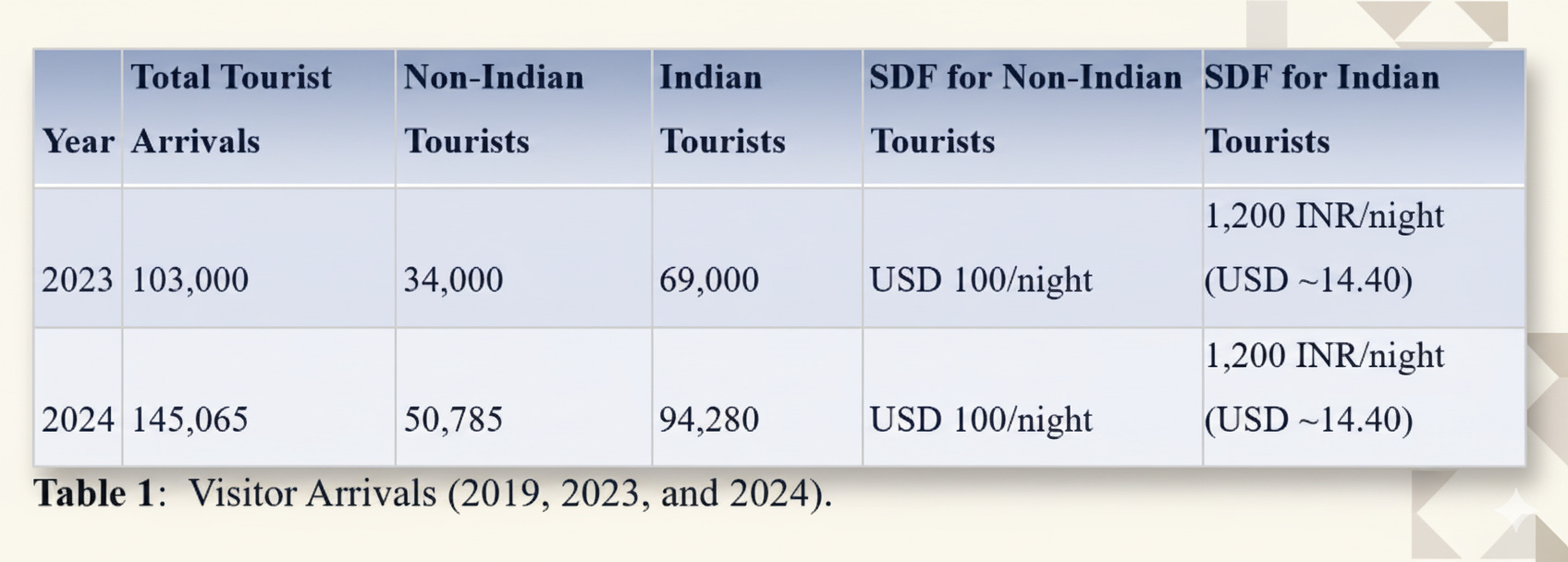
The falling numbers and competitiveness led the authorities to reduce the SDF in 2022 from US$200 to US$100 per person per night, accompanied by tiered pricing systems for Indian tourists, who pay an SDF of 1,200 INR (US$14.40), do not pay a for a visa and receive incentives allowing them to buy duty-free gold. Despite these incentives, there was a 67% drop in tourist arrivals from 315,599 visitors in 2019 to 103,000 in 2023, (Table 1), a number far below the country’s subjective annual ‘target’ of 300,000 annual visitors. In 2024, approximately 65% of total tourist arrivals were Indian nationals, a figure that hasn’t changed radically over the past decade. Differential treatment for Indian and other regional visitors, is driven by regional politics than simply a quest for sustainable tourism, and complicates narratives about universal sustainability principles, From an Indian perspective, Bhutan is often framed as a budget destination (Lal, 2024), with a subsequent lower daily spend than other international tourists (Pek-Dorji, 2019). It suggests that the SDF functions not as a fixed sustainability instrument but as a highly dynamic tool prioritising economic recovery and real-politick over philosophical consistency, undermining its claim to universal, consistent sustainability principles.
Mass Migration and Brain Drain
Perhaps the most significant challenge to academic idealisations of Bhutan emerges from unprecedented outward migration. Between 2022 and 2024, more than 20,000 Bhutanese, left their homeland seeking better opportunities abroad, with approximately half departing from the civil service (Wangdi, 2025). This mass exodus represents a classic brain-drain scenario and fundamental challenges assumptions about GNH’s effectiveness in creating conditions for human flourishing (Alaref et al., 2025) and tourism’s role in the economy. Despite decades of policies supposedly prioritising holistic well-being over material prosperity, educated Bhutanese are abandoning their homeland for economic opportunities elsewhere, where they often accept significant status reductions. The low wages also extend to the tourism sector, with wages peaking around the ages 30-34 (World Bank, 2025).
Prime Minister Tshering Tobgay acknowledged in 2025 that “the large-scale departure of skilled individuals poses a serious risk to the nation’s development” (Wangdi, 2025), leading to extended hospital waiting times, inexperienced teachers, and widespread job vacancies. Former Prime Minister Lotay Tshering’s (2018-2023) frank admission, “We are poor… Many people refer to Bhutan and Bhutanese as the happiest country in the world. We are not” (Li and Hassan, 2025), reveals the disconnect between international perceptions and domestic realities.
Speculative Development – The Gelephu Mindfulness City Controversy
The proposed Gelephu Mindfulness City (GMC), three times the size of Singapore, is designed to accommodate 150,000 residents, represents a contradiction of sustainable tourism principles. This megaproject with its own legal, judicial, and governance framework, is backed by the monarchy and promoted as a solution to economic pressures. The city, set for competition in 2029, along with its new airport, projected to handle 5.5 million passengers by 2065 represents a dramatic departure from Bhutan’s established ‘low-impact’ principles, fundamentally violating the development philosophy that supposedly governs the country.
Envisioned as a major drawcard for wellness tourism and those interested in mindfulness, well-being, and Bhutanese culture, the city can be interpreted as a strategic pivot and an implicit admission of the original tourism model’s insufficiency. The Gelephu project, therefore, represents a high-stakes, speculative gamble on high-end and high-growth tourism.
More troublingly, the project is being constructed on lands from which ethnic Nepali Lhotshampas were forcibly expelled during the 1990s ethnic cleansing campaigns. Displaced refugees like Krishna Bir Tamang, still residing in Nepali camps after 32 years, describe the development as being built on a historical injustice (Bhandari, 2024). Largely absent from academic discussions of Bhutan’s sustainability model, the project reveals how idealised narratives can obscure systematic human rights violations. Cultural anthropologist Rieki Crins, who lived in Bhutan for 25 years before being blacklisted, describes the kingdom as becoming a “Buddhist Disneyland” where “the Bhutan government needs a distraction, and they keep putting out propaganda like the gross national happiness or mindfulness city” (Bhandari, 2024). Such critical perspectives rarely penetrate tourism academic literature, which tends to reproduce official narratives rather than engaging with dissenting voices.
Discussion
The Sustainability Paradox: When Models Fail to Deliver
The disconnect between theoretical sustainability and practical necessity suggests the model itself is flawed, academic representations of it are problematic, and any policy transfer attempts are misguided.
Bhutan’s tourism model is fundamentally flawed due to a core sustainability paradox. Despite decades of policies supposedly prioritising environmental protection and balanced tourism development, the model has proven systemically inadequate to address operational challenges or deliver sustainable tourism. The evidence reveals infrastructure that cannot accommodate limited tourist numbers in the primary northern and western circuit (Thimphu/Paro/Punakha), while hotels in eastern regions suffer occupancy levels of only 10-20% (Dolkar, 2024). Additional problems include dependence on mass market, low-budget Indian tourists (Penjor, 2019), extreme seasonality with 80 percent of tourists visiting during just six months (Dorji, 2001), overcrowding at key attractions and persistent service quality deficiencies (Pek-Dorji, 2019). These operational failures fundamentally contradict the GNH principles that supposedly guide the model.
The model’s inherent contradictions become apparent when examining policy responses. The celebrated ‘high-value, low-impact’ framework paradoxically requires substantial infrastructure investment, enhanced skills training, and aggressive international marketing—interventions that directly contradict its stated sustainability positioning. This reveals how academic representations have obscured practical inadequacies by privileging theoretical aspirations over operational realities.
Academic misrepresentation becomes apparent when examining how scholars characterise policy evolution without acknowledging underlying implementation shifts. Prime Minister Lotay Tshering’s redefinition suggests the model’s foundational concepts have become sufficiently malleable to accommodate contradictory interpretations: ‘When we say high value, we don’t mean rich tourists. When we say low volume, we don’t mean less in number. When we say high value it’s not just for tourists, it’s for all of us’ (Daily Mirror, 2023). This rhetorical flexibility demonstrates that the foundational model lacks coherent meaning, having been stretched beyond recognition to accommodate economic imperatives.
The shift from ‘high-value, low-volume’ to ‘high-value, low-impact’ in 2008, driven by external consultants, particularly McKinsey & Company (Ura, 2015), exposes how supposedly indigenous development models succumb to external pressures prioritizing growth over sustainability. This represents compelling evidence against academic idealization rather than inherent policy failure. While the development of an Integrated Tourism Master Plan 2025-2034 represents progress, the SDF remains the primary policy tool—functioning merely as a blunt revenue-generating instrument that is increased or decreased based on tourist numbers (Pitrelli, 2024). However, the SDF cannot address tourism imbalances, low wages, or enable year-round destination positioning, and it potentially undermines demand for longer-stay ecotourism and retreat markets that could provide genuine sustainable benefits (Gurung and Seeland, 2008).
These policy flaws and malleability render transfer attempts fundamentally misguided. Applying Rorschach’s inkblot metaphor, Bhutan’s approach enables international observers to project sustainability ideals onto policies fundamentally altered from their original intent. This academic idealisation creates significant risks when other destinations attempt replication without understanding specific enabling conditions. For example, in New Zealand, the Visitor Conservation and Tourism Levy (IVL) has been blamed by Aotearoa, the country’s independent tourism body for been partially responsible for sluggish tourist numbers growth, which remain below pre-pandemic levels. In Bali, as many as 60% of all international arrivals have been failing to pay the levy (Bali Sun, 2024). The scholarly consensus advocating tourist fees based on the Bhutan model, fails to adequately address how Bhutan’s small population, and an overarching philosophy and tourism policy created and guided by the Bhutanese monarchy create conditions that may not exist elsewhere.
While Bhutan’s identified challenges—infrastructure constraints, low wages, and seasonality—represent developmental problems common to many countries, these issues become particularly significant when examined against the model’s sustainability claims. The crucial distinction lies not in the existence of these challenges, but in how academic representations have obscured their severity while promoting the model as uniquely transformative. The fundamental question is whether Bhutan’s approach represents genuine innovation capable of transcending conventional development limitations, or sophisticated branding that masks standard tourism challenges behind sustainability rhetoric.
As the gap widens between sustainability discourse and measurable outcomes—evidenced by mass emigration, persistent service quality deficiencies, and infrastructure inadequacies—the model’s celebrated uniqueness appears less as revolutionary framework than as carefully constructed narrative. Rather than demonstrating how sustainable tourism principles can overcome common developmental constraints, Bhutan’s experience suggests that even well-intentioned policies struggle with the same operational realities facing destinations worldwide. The model’s apparent distinctiveness lies primarily in its marketing sophistication rather than its practical effectiveness in addressing fundamental tourism development challenges.
Conclusion
The academic idealisation of Bhutan as a sustainable tourism exemplar reflects broader problems in scholarly engagement with tourism concepts, development models, and policy transfer. This analysis demonstrates that the model itself contains structural contradictions, academic representations suffer methodological limitations, and policy transfer attempts lack conceptual rigor. Bhutan’s tourism approach has achieved certain limited objectives—environmental branding and ‘Last Shangri-La’ marketing—while systematically failing at employment quality, economic sustainability, and operational effectiveness. These mixed outcomes invalidate claims of universal applicability and expose how academic idealisation obscures complex realities and internal contradictions that compromise both sustainability and transferability.
Contemporary challenges reveal fundamental tensions between idealised policy frameworks and pressures of economic modernization, demographic change, and global integration. Mass outward migration, controversial megaprojects, and the sustainability paradox demonstrate that idealized models prove less robust than scholarly literature suggests. Academic narratives celebrating Bhutan’s tourism success disconnect from domestic realities, perpetuating romanticised representations that serve neither scholarly understanding nor practical policy development.
Moving forward, academic engagement with tourism and development models requires critical, contextual, and temporally sensitive approaches. This necessitates abandoning celebratory case studies for nuanced analysis that acknowledges failures alongside successes, contextual specificities alongside universal principles, and practical constraints alongside theoretical aspirations. Tourism destinations worldwide deserve academic analysis providing realistic assessments rather than idealised templates disconnected from complex realities.
Only through such critical engagement can scholarship contribute meaningfully to developing tourism models capable of addressing contemporary challenges while remaining adaptable to future pressures. The fundamental question remains whether country-wide models demanding tourist levies represent sustainable policy frameworks or sophisticated marketing strategies masquerading as innovative development approaches.
#Bhutan #idealised #tourism
References
Alaref, J., Etang Ndip, A., Dorji, C. and Martinoty, L. (2025), Migration Dynamics in Bhutan: recent trends, drivers, and implications, World Bank Group, available at: https://documents1.worldbank.org/curated/en/099071025222089550/pdf/P509392-07140ea4-b0fa-489b-a384-7e7494758a5e.pdf
Bali Sun (2024), “Tourists Must Remember To Pay Bali Tourism Tax This High Season,” December 5, available at: https://thebalisun.com/tourists-must-remember-to-pay-bali-tourism-tax-this-high-season/
Bhandari, B. (2024), “Displaced ethnic Nepalis fume over Bhutan’s ‘mindfulness city’ plan”, South China Morning Post, 2 December, available at: https://www.scmp.com/week-asia/politics/article/3288697/displaced-nepalis-fume-bhutans-mindfulness-city-plan-our-stolen-land
Brunet, S., Bauer, J., De Lacy, T., and Tshering, K. (2001), “Tourism development in Bhutan: Tensions between tradition and modernity”, Journal of Sustainable Tourism, Vol. 9 No. 3, pp. 243-263, doi: 10.1080/09669580108667401.
Daily Mirror (2023), “Bhutan Being Promoted as a High-End Tourist Destination”, 5 February, available at: https://www.dailymirror.lk/amp/asia/Bhutan-Being-Promoted-as-a-High-End-Tourist-Destination/81-254842.
Dolkar, D. (2024), “Samdrupjongkhar gateway fails to deliver tourism boom for the East,” Kuensel Online, December 2, available at: https://kuenselonline.com/news/samdrupjongkhar-gateway-fails-to-deliver-tourism-boom-for-the-east.
Dorji, T. (2001), ‘Sustainability of tourism in Bhutan’, Journal of Bhutan Studies, Vol. 3 No. 1, pp. 84–104.
Gurung, D. B., and Seeland, K. (2008), “Ecotourism in Bhutan: Extending its benefits to rural communities”, Annals of Tourism Research, Vol. 35 No. 2, pp. 489-508, doi: 10.1016/j.annals.2008.02.004.
Lal, P. V. (2024), “Budget travel guide: Bhutan in less than ₹1.25 lakh”, Hindustan Times, December 7, available at: https://www.hindustantimes.com/lifestyle/travel/budget-travel-guide-bhutan-in-less-than-rs-1-25-lakh-101733542529770.html
Li, S. and Hassan, A. (2025), “A Remote Himalayan Kingdom Bet Big on Bitcoin Mining. So Far, It Has Paid Off”, Wall Street Journal, June 26, available at: https://www.wsj.com/world/asia/a-remote-himalayan-kingdom-bet-big-on-bitcoin-mining-so-far-it-has-paid-off-a28bc4b8?mod=e2tw
Nyaupane, G. P., and Timothy, D. J. (2010), “Power, regionalism and tourism policy in Bhutan”, Annals of Tourism Research, Vol. 37 No. 4, pp. 969-988, doi: 10.1016/j.annals.2010.03.006
Peak Travel (2025), “Bhutan’s Radical Approach to Overtourism”, WHYY, March 11, https://whyy.org/episodes/bhutans-radical-approach-to-overtourism/.
Pek-Dorji, S. S. (2019), “Transforming The Economy Through Tourism: A High Value, Low Impact Dilemma,” The Druk Journal, Vol. 4, Issue 4, available at: https://drukjournal.bt/transforming-the-economy-through-tourism/
Penjor, U. (2019), “Tourism and Hotels,” The Druk Journal, Vol. 5, Issue 2, pp. 40-46, available at: https://drukjournal.bt/wp-content/uploads/2021/06/Tourism-and-Hotels.pdf
Pitrelli, M. (2024), “Think Bhutan’s $100 daily tourism fee is pricey? It could go even higher, says prime minister”, CNBC, May 20, available at: https://www.cnbc.com/2024/05/21/bhutan-may-revise-its-sustainable-development-fee-if-travel-picks-up.html
Rinzin, C., Vermeulen, W. J., and Glasbergen, P. (2007), “Ecotourism as a mechanism for sustainable development: the case of Bhutan”, Environmental Sciences, Vol. 4 No. 2, pp. 109-125m doi: 10.1080/15693430701365420.
Rudigier, C. (2023), “Preservation of a Paradise: What Can We Learn from Bhutan’s Approach to Sustainable Tourism?”, TEDxVienna Magazine, 19 July, available at: https://magazine.tedxvienna.at/2023/07/19/sustainable-tourism-in-bhutan/
Schroeder, K. (2015), “Cultural values and sustainable tourism governance in Bhutan. Sustainability”, Vol. 7 No. 12, pp. 16616-16630, doi: 10.3390/su71215837.
Ura, K. (2015), The experience of gross national happiness as development framework (South Asia Working Paper Series No.42). Asian Development Bank.
Wangdi, P. (2025),” Bhutan grapples with void left by Australia-bound public servants. Nikkei Asia, July 19, 2025, available at: https://asia.nikkei.com/spotlight/big-in-asia/bhutan-grapples-with-void-left-by-australia-bound-public-servants.
World Bank (2024), Bhutan Country Economic Memorandum: Maximizing Bhutan’s Potential for Economic Diversification and Structural Transformation. Washington, D.C.: World Bank Group, available at: http://documents.worldbank.org/curated/en/099090324133081117
Reposted from substack
#SustainableTourism #Overtourism #TourismDegrowth #BhutanTourism #GrossNationalHappiness #CriticalTourismStudies #TourismResearch #AcademicCritique #TourismPolicy #SustainabilityMyth #TourismGeography #HighValueLowImpact #TouristTax #ResponsibleTravel